
Don’t Forget the Basics
The Most Common Mistake New Medics Make. And why the world’s best operators already know the answer.

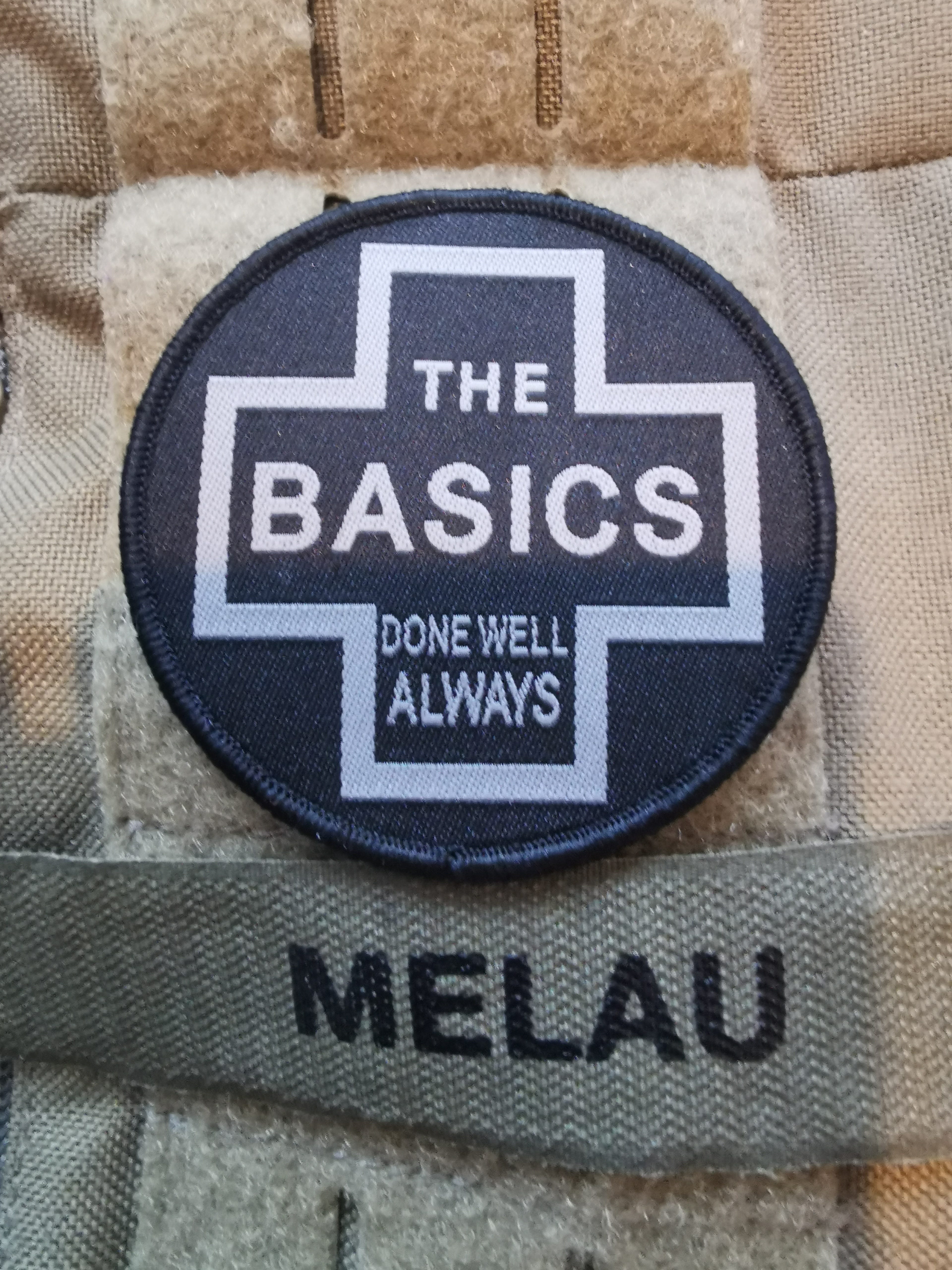
I love this badge. It comes from a British Police Medic.
A few weeks ago, we hosted a Q&A session for new NSOCM medics. Experienced medics and doctors in the room, a relaxed atmosphere, and yes — a beer in hand. The kind of setting where honest conversations actually happen.
One question stood out above the rest:
“What is the most common mistake new medics tend to make?”
Good question. And I’ve been thinking about it ever since.
I’ve Been That Medic
Let me be upfront: I’ve made more mistakes than I can count. Some of them are vivid memories I’d rather forget. Others, in hindsight, are pretty funny. And here’s the thing — even now, with years of prehospital experience behind me, I still make mistakes. Regularly.
So when the new medics in the room looked around for an answer, they weren’t looking at someone who had it all figured out. None of us does.
But when I was asked what the single most common mistake is? My answer was straightforward:
New medics forget the basics.
Not because they’re careless. Not because they haven’t studied. Usually, it’s the opposite — they’re so eager to demonstrate their knowledge, so keen to reach for the advanced intervention, that the foundational steps get rushed or skipped entirely.
Sound familiar?
The Humbling Day I Walked Into a Special Forces Training Session
Several years ago, I was invited to teach a few days of prehospital emergency medical procedures to a Special Forces group. High-stress scenarios, realistic environments — the kind of training I’d done plenty of times before.
I walked in with confidence. I was a rescue paramedic. I had experience. I genuinely thought I had something to offer them that they hadn’t seen before.
Within a few hours, I was humbled.
These operators were exceptional. Not in the way I expected — not because of exotic interventions or advanced clinical knowledge. They were exceptional because they had mastered the fundamentals to a degree I hadn’t anticipated. Their patient assessments were methodical and calm under pressure. Their hemorrhage control was fast, clean, and correct every single time. Their airway management wasn’t flashy — it was just right.
I adjusted my approach, continued with humility, and left that session having learned far more than I taught.
What I took home wasn’t a new skill. It was a reminder of an old one: mastery isn’t about complexity. It’s about owning the basics so completely that they become second nature.
What the Special Forces Already Know
Around the same time, the Norwegian newspaper VG ran a piece on the Norwegian Special Forces (FSK). A reporter asked one of their commanders what made SOF operators so effective. The answer, translated from Norwegian:
“SOF operators excel — they are truly the best. Many believe it’s due to their high-tech equipment and modern gear, but the truth is that rigorous training is what sets them apart. SOF operators are exceptionally skilled in the basic skills.”
Not cutting-edge gear. Not advanced pharmacology protocols. Basic skills, relentlessly trained.
This isn’t just military folklore. The research backs it up.
What the Science Says
In the 1990s, psychologist K. Anders Ericsson introduced what became one of the most influential frameworks in performance science: deliberate practice. The core idea is that expert performance isn’t the result of raw talent or years of passive experience — it’s the product of focused, intentional repetition of specific skills, ideally with feedback and the goal of continuous refinement.
Ericsson and colleagues found something counterintuitive: simply accumulating experience in a domain does not, by itself, lead to improved performance. What matters is how you practice, not just how long. (Ericsson KA. Academic Emergency Medicine, 2008)
In medical education, this framework has been validated repeatedly. A study published in BMC Medical Education found that clinical skill test results correlated positively with deliberate practice behaviours — specifically, planning and sustained concentration — among medical students across all year groups. (Moulaert et al., BMC Medical Education, 2011)
Ericsson himself, writing specifically about medicine, argued that the goal of training should not be achieving an “adequate level” of performance — it should be reproducibly superior performance in the skills that matter most. (Ericsson KA. Academic Medicine, 2004)
In military medicine, there is no more powerful example of this principle than Tactical Combat Casualty Care (TCCC). TCCC wasn’t built around exotic interventions. It was built around the systematic, evidence-based mastery of a small number of high-impact skills, like haemorrhage control and airway management. The result? Combat fatality rates dropped from 19.1% in World War II to 9.4% during operations in Iraq and Afghanistan. (Puryear et al., StatPearls, 2022)
Not because of high-tech equipment. Because the right people had mastered the right basics — and trained them relentlessly.
What “The Basics” Actually Means in Prehospital Medicine
It’s important to be specific here, because “back to basics” can seem like a cliché if you don’t clarify it.
In prehospital medicine, basic skills are the foundation everything else is built on. A systematic patient assessment. Scene safety. A clear, structured handover. Airway positioning before reaching for an advanced device. Proper tourniquet placement. Recognising deterioration early.
These aren’t beginner tasks you graduate from. They’re the skills that separate a good clinician from a great one — because great clinicians execute them correctly, every time, regardless of what else is happening around them.
Patricia Benner’s seminal nursing framework From Novice to Expert (1984) described something similar: the expert clinician doesn’t necessarily do more than the novice. They do the fundamentals with greater speed, precision, and situational awareness. The expert sees what matters. The novice reaches for complexity as a substitute for clarity.
This maps almost perfectly to what I saw in that SF training session many years ago. And it maps to what I see today in new medics who are struggling.
Why New Medics Drift From the Basics
Here’s what I think actually happens.
You train hard. You absorb a huge amount of information. You come out of your course with knowledge of drugs, devices, procedures — and you want to use them. Advanced skills feel like evidence of competence. Basic skills feel like something you already know.
But there’s a difference between knowing something and owning it under pressure.
When stress is high, cognitive load increases, and the first things to degrade are the steps you haven’t automated. If your patient assessment isn’t deeply habitual, it gets compressed or skipped. If your communication under pressure isn’t practised, it becomes fragmented. The basics break down first — precisely because they haven’t been drilled to the level where they’re stress-resistant.
This is why Ericsson’s deliberate practice model is so relevant here. It’s not enough to do a skill once in training and check it off. The goal is to reach a level of automaticity where the skill holds up when everything else is going wrong.
An Honest Question for You
Before you move on, I want to leave you with something to actually sit with — not just read and forget.
When did you last actively audit your own basic skills?
Not just perform them in the flow of a busy shift, but genuinely stop and ask: Am I doing this well? Is my patient assessment systematic every time? Is my airway management as clean as it could be? Do I communicate clearly under pressure, or do I just think I do?
The really great people are not exceptional because they were born that way. They are exceptional because they have committed to mastering what most people take for granted — and they never stop refining it.
That’s available to all of us.
So — how are your basic skills, really?
References:
Ericsson KA. Deliberate Practice and Acquisition of Expert Performance: A General Overview. Academic Emergency Medicine. 2008;15(11):988–994.
Ericsson KA. Deliberate practice and the acquisition and maintenance of expert performance in medicine and related domains. Academic Medicine. 2004;79(10 Suppl):S70–81.
Moulaert V et al. The role of deliberate practice in the acquisition of clinical skills. BMC Medical Education. 2011;11:101.
Puryear B, Roarty J, Knight C. EMS Tactical Combat Casualty Care. StatPearls. Updated October 2022.
Benner P. From Novice to Expert: Excellence and Power in Clinical Nursing Practice. Prentice Hall Health, 1984.
Enjoyed this one while having breakfast before training with SFO today. I really think there is potential in you doing some videos with the “basics of paramedics” for athletes, so many in the bike, road and trails, non of them carry a tourniquet, or knows how to control/prevent bleeding, hypothermia, or perform a CPR and some other basics. 🤙